
Pets are more than just animals we care for—they’re companions, confidants, and, for many, full-fledged family members. We open our hearts (and wallets) for them, giving them affection, time, and a place in our homes.
This deep connection is nothing new. Across cultures and centuries, animals have been portrayed in stories, artworks, and household artifacts. What has changed is the degree to which pets have become central to our daily lives—not just as animals we live with, but as emotional anchors and beloved companions. Media and pop culture, with their countless animal characters, have only deepened this bond.
Why do pets matter so much to us? What do they really bring to our lives? And do they actually make us happier? These are all questions worth asking.
Ask a pet owner and you’ll likely hear an enthusiastic “Absolutely!” But scientific research tells a more nuanced story.

Pets and Physical Health: The Dog-Walking Advantage
Since the 1980s, researchers have tried to understand how pets affect our health, especially our physical wellbeing. The findings are mixed, but there are some encouraging patterns—especially when it comes to dogs.
One large-scale review of studies found that owning a dog is linked to a 24% lower risk of death from any cause, particularly among people who had previously experienced heart issues (Kramer et al., 2019). Why? It’s likely a combination of stress reduction, lower blood pressure, companionship—and most notably, more physical activity. Walking a dog encourages movement, routine, and social interaction, all of which contribute to better health.
Pets and Mental Health: Mixed Messages
Mental health is where things get a little murkier.
Some studies show that pet owners are happier and less lonely. Others find the opposite: higher levels of depression and isolation among those with pets. How could this be?
It turns out the impact may depend on how pets are integrated into someone’s lifestyle. If having a pet leads to more physical activity—like walking, play, or outdoor time—the mental health benefits are more likely to show up (Martins et al., 2023). For older adults in particular, pets can reduce feelings of loneliness, provide a sense of purpose, and help combat boredom (Cherniack & Cherniack, 2014; Hughes et al., 2019).
But pet ownership isn’t always a source of joy. Caring for an animal can be stressful, especially when it comes to:
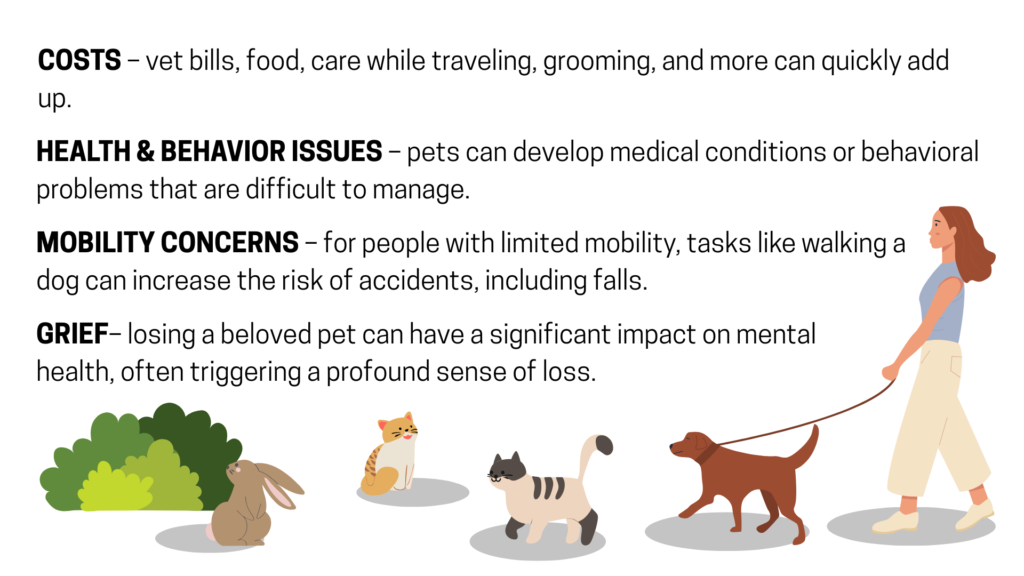
These challenges don’t mean pet ownership isn’t worth it—but they’re important parts of the story.
Why It’s Hard to Measure the Human–Pet Bond
Part of the reason research results vary is that studying the relationship between pets and human wellbeing is incredibly complex.
For example, someone who feels lonely or depressed might decide to get a pet in hopes of feeling better. Later, if a study compares pet owners with non-pet owners, it might find that the pet owners are still struggling. But it’s impossible to know how they would have felt without the pet. In other words, they might be better off than they would have been, even if they’re not “better” than the average person.
This makes it hard for researchers to draw clear, cause-and-effect conclusions.

The Takeaway: Pets Matter, Even If Science Can’t Always Explain Why
In the end, many of us can’t imagine life without our pets—whether they bark, purr, chirp, whinny, swim, or slither.
They give us someone to care for, a reason to get out of bed, and a warm (or feathery, or scaly) presence to come home to. They listen without judging, love unconditionally, and often seem to understand us in ways that words can’t explain.
While the scientific community continues to debate how—and how much—pets improve our health, most pet owners would say the answer is obvious.
If science hasn’t quite captured the depth of the human–animal bond, maybe that’s not a flaw in the bond itself—but simply a reminder that not everything that matters can be easily measured.